Milk Delivery Software: The Complete Guide to Digitizing Your Dairy Business in 2026
Introduction: Why Every Dairy Business Needs Milk Delivery Software
Waking up at 5 AM to note down orders, calling customers to confirm quantities, maintaining handwritten registers, and going door-to-door at month-end to collect payments — this has been the daily routine of a traditional milk delivery business for decades. But as customers go digital, their expectations are changing too. They now want to place an order in one tap, pay online, and track their delivery in real time.
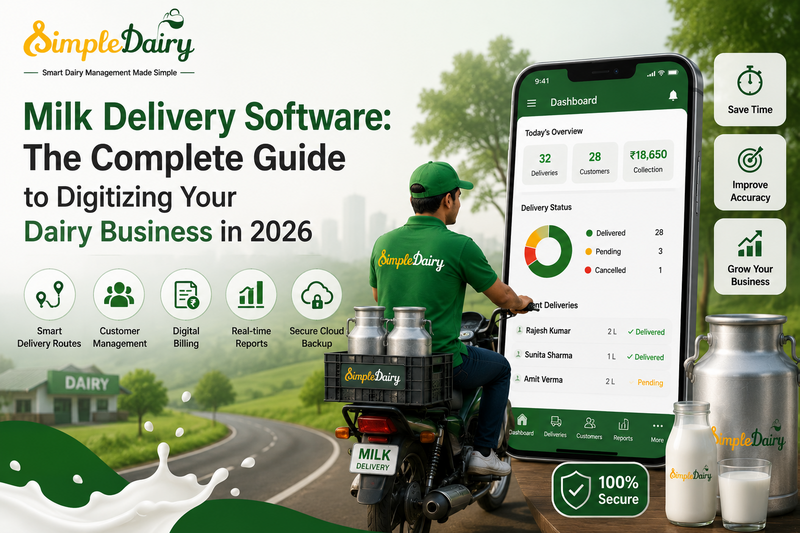
This is exactly where milk delivery software comes in. It's a complete digital solution that helps dairy farms, local milkmen, and milk subscription businesses manage their entire operation — from order booking to delivery tracking, billing, and customer management — all on a single platform.
In this blog, we'll break down what milk delivery software actually is, how it works, which features matter most, and how to choose the right one for your business.
What Is Milk Delivery Software?
Milk delivery software is a cloud-based or mobile application designed to automate the entire workflow of a dairy or milk delivery business. It typically involves three types of users:
- Admin/Business Owner – who oversees and controls the entire operation
- Delivery Agent – who follows optimized routes to complete actual deliveries
- Customer – who places orders through an app or website
This software can manage subscription-based milk delivery (daily doorstep milk), one-time orders, and other dairy products like ghee, paneer, curd, and butter. From small local dairies to large-scale milk delivery startups, this tool plays a critical role in helping businesses scale efficiently.
Problems With Traditional Milk Delivery Businesses
Before diving deeper into the software itself, let's understand the pain points of running a manual operation:
- Manual Record Keeping – Handwritten registers, frequent errors, lost or misplaced data
- Payment Collection Delays – Cash collection issues and difficulty tracking defaulters
- Time-Consuming Route Planning – Manually briefing delivery staff on routes every day
- Customer Complaints – Wrong deliveries, missed deliveries, and zero visibility into delivery status
- Subscription Management Chaos – Keeping track of who's on holiday, who changed their quantity, and who paused their subscription
- No Business Insights – No clear data on daily sales volume, high-demand areas, or profitability
These challenges directly impact both business growth and customer satisfaction. That's exactly why more and more dairy businesses in 2026 are shifting toward an online milk delivery app or comprehensive dairy management software.
Key Features of Milk Delivery Software
If you're evaluating software for your business, make sure it includes the following features:
1. Subscription Management
Customers should be able to set up daily, alternate-day, or weekly subscriptions, adjust quantities, and mark holidays — this is the core feature of any good milk subscription software.
2. Automated Route Optimization
Delivery agents get the most efficient route automatically, saving both time and fuel.
3. Real-Time Order Tracking
Customers can see exactly when their milk will be delivered, which builds trust and transparency.
4. Digital Payment Integration
UPI, digital wallets, and credit-based billing options make payment collection seamless, eliminating the hassle of manual cash handling.
5. Automated Billing & Invoicing
Weekly or monthly invoices are generated automatically, minimizing billing errors.
6. Inventory & Stock Management
Beyond milk, products like ghee, paneer, and curd can also be tracked for stock levels.
7. Multi-Vendor / Multi-Branch Support
If you operate across multiple areas or run a franchise model, everything can be managed from a single dashboard.
8. Analytics & Reporting
Insights into daily sales, area-wise demand, and customer retention make business decisions much easier.
9. Customer App & Admin Panel
A user-friendly milk delivery app enhances the customer experience, while the admin panel gives business owners complete control.
How Milk Delivery Software Works
Here's a simple breakdown of the typical workflow:
- Customer Registration – Customers download the app and set up their subscription preferences
- Order Confirmation – The system automatically generates the next day's orders based on active subscriptions
- Route Assignment – Delivery agents receive an optimized route for their assigned area
- Delivery & Confirmation – Agents complete deliveries and update the status directly in the app
- Billing – The system automatically generates bills based on actual usage
- Payment Collection – Customers pay online, or amounts are auto-deducted from their wallet
- Reporting – Business owners get real-time data through a centralized dashboard
This entire process minimizes manual intervention, saving time and significantly reducing errors.
Who Can Use Milk Delivery Software
- Local Milkmen/Vendors looking to digitize their small business
- Dairy Farms that supply milk directly to consumers
- Milk Subscription Startups running app-based delivery models
- Cooperative Dairies serving thousands of customers
- Grocery/Kirana Stores wanting to offer milk delivery as an added service
Whether your business is small or large, a scalable milk delivery management system can be customized to fit businesses of any size.
Business Benefits of Milk Delivery Software
Operational Efficiency
Automating manual tasks saves time and manpower, allowing business owners to focus on strategic growth instead of day-to-day admin work.
Better Customer Experience
Easy ordering, transparent tracking, and digital payments improve customer satisfaction — which drives repeat business and referrals.
Reduced Errors
Automated billing and order management minimize human errors, directly preventing revenue leakage.
Scalability
As your business grows, adding new customers and expanding to new areas becomes far easier with software — without a proportional increase in manual effort.
Data-Driven Decisions
Sales reports and customer analytics help you decide which areas to expand into or which products are in high demand.
Increased Revenue
Timely payment collection, upselling opportunities (like ghee or paneer add-ons), and better customer retention all contribute positively to overall revenue.
How to Choose the Right Milk Delivery Software
Keep these factors in mind while selecting software for your business:
- Ease of Use – The software should be simple enough for both delivery agents and customers to use without training
- Customization – It should adapt to your business model (subscription, one-time orders, multi-vendor)
- Payment Gateway Integration – Support for popular local payment methods (UPI, cards, wallets)
- Scalability – The software should grow along with your business
- Customer Support – Reliable and responsive technical support
- Pricing Model – Choose between one-time cost or subscription-based pricing depending on your budget
- Data Security – Customer data and payment information must be securely protected
Keeping these factors in mind will help you choose a dairy management software that works well for your business in the long run.
Emerging Trends in the Milk Delivery Industry for 2026
- AI-Based Demand Prediction – Machine learning helps forecast how much milk a particular area will need the next day
- Voice & Chatbot Ordering – Customers are increasingly placing orders via WhatsApp or voice assistants
- Eco-Friendly Delivery – Reusable containers and sustainable packaging are becoming a growing trend
- Hyperlocal Delivery Models – Faster, localized delivery models ensure fresher products
- Integrated Loyalty Programs – Rewarding repeat customers is proving effective for boosting retention
These trends clearly show that technology is becoming a core part of the dairy industry's future.
Frequently Asked Questions (FAQs)
Q1. How much does milk delivery software cost?
Ans: Pricing depends on the software provider, feature set, and the size of your business. Affordable monthly subscription plans are available for small vendors, while enterprise-level solutions come with custom pricing.
Q2. Can small local milkmen also use this software?
Ans: Absolutely. Today, there are simple and affordable milk delivery apps specifically designed for small vendors, allowing them to digitize their business without a large upfront investment.
Q3. How are payments managed in milk delivery software?
Ans: Most software supports UPI, digital wallets, and card payments. Some platforms also allow credit-based billing, where customers pay at the end of the month.
Q4. Is this software only for milk, or can it manage other products too?
Ans: Modern milk delivery software can manage other dairy products as well — including ghee, paneer, and curd — allowing businesses to run their entire dairy operation from a single platform.
Q5. How long does it take to implement milk delivery software?
Ans: This depends on the provider and level of customization required, but most cloud-based solutions can typically be set up within a few days.
The milk delivery business is no longer confined to traditional methods — it's rapidly moving toward digital transformation. If you want to make your dairy or milk delivery business more efficient, improve customer satisfaction, and increase revenue, investing in reliable milk delivery software has become a necessity rather than an option.
Choosing the right software doesn't just simplify your daily operations — it transforms your business into a scalable, future-ready model built for long-term growth.
 WhatsApp